
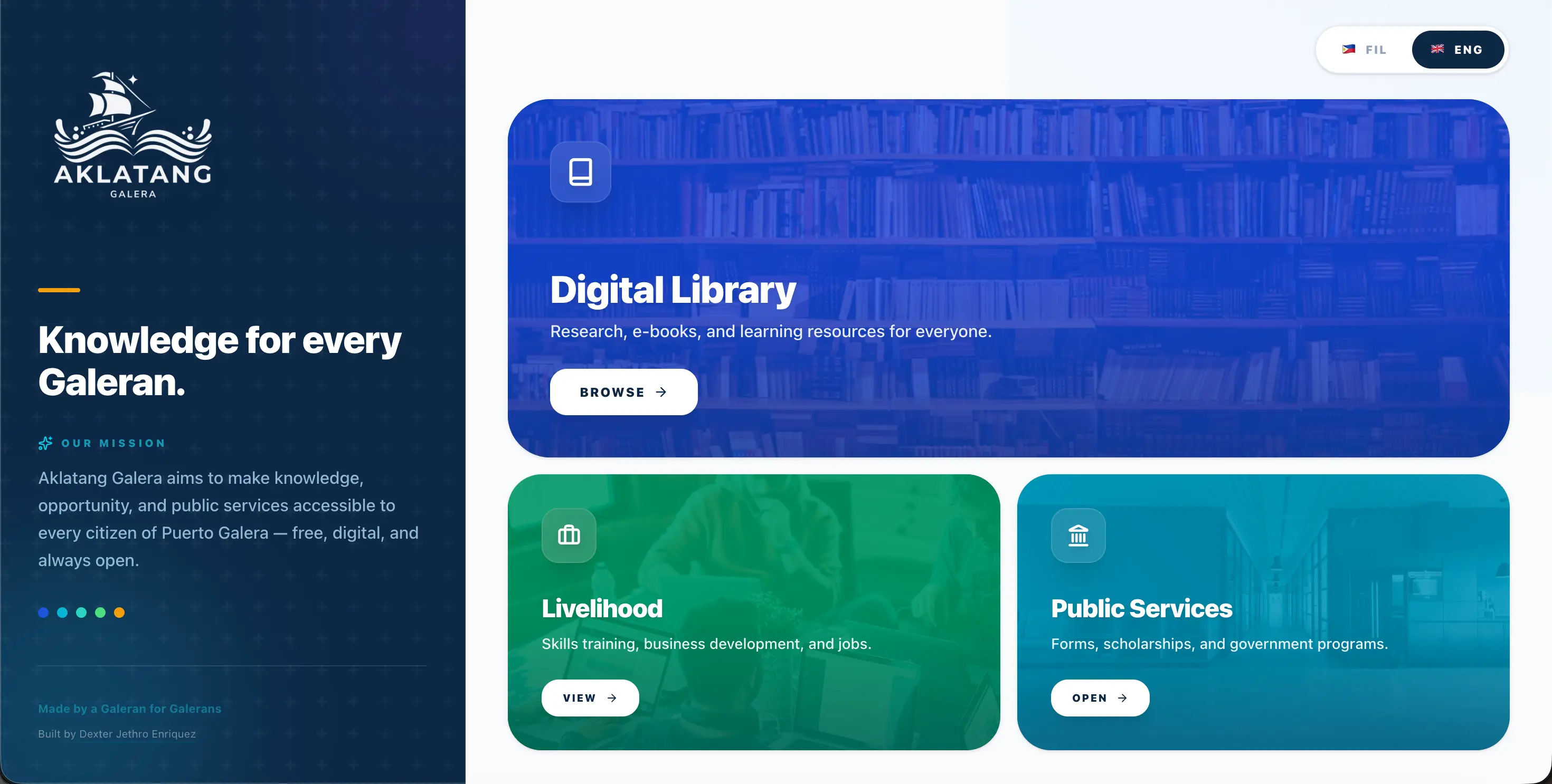
Aklatang Galera
A bilingual civic portal for Puerto Galera’s education, livelihood, and public services.
- Role
- Sole developer
- Timeline
- One week, Mar 15 to 21, 2026
- Team
- Solo
- Stack
- Next.js
- TypeScript
- Tailwind
- Result
- Hundreds of users, mostly students
Why can't PG have this?
I was locked in on building things back then. Then our NSTP immersion took me to Barangay Bagong Silangan, and to its library: three computers, each showing just three shortcuts the SK had set up. Their SK officials told me it had become an easy way for students to find what they needed. (I wrote the whole day up in Building with what you have.)
So I thought: why can't PG have this?
Back in high school, finding resources at home was pahirapan. Articles sat behind paywalls. The AI chatbots of the time made up sources that didn't exist. Local literature was too scattered to find. What if all of it lived in one place?
Then I noticed the same gap in opportunities, so the idea grew past students. Job postings and courses worth taking belonged there too.
Three doors
Aklatang Galera is a simple site with three big buttons. Need studies or literature? Digital Library. Looking for work or training? Hanapbuhay. Need forms, scholarships, or government programs? Serbisyong Pampubliko. Like that screen in Bagong Silangan, the useful stuff is already one tap away.
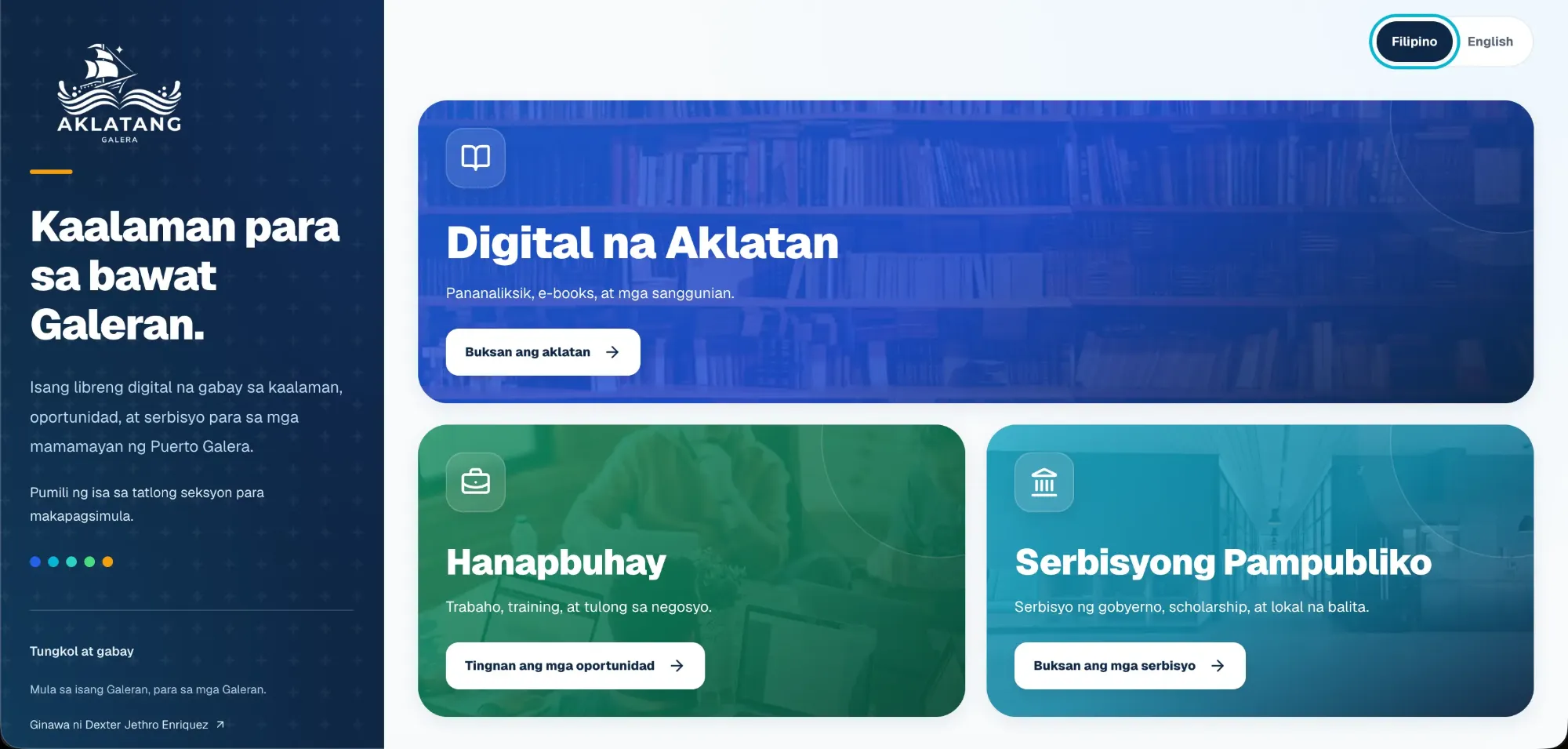
Behind those three doors sit 105 free resources: 44 databases in the Digital Library, 28 job, training, and business links in Hanapbuhay, and 33 government services, scholarships, and transparency portals in Serbisyong Pampubliko. Some only make sense in PG, like the eLGU portal for permits and cedula, or the PPA system for booking port trips without the long queue.
The Digital Library also has a smart search powered by Semantic Scholar, and it's honest about its limits. It tells you upfront that it can miss Philippine and Filipino-language work, and points you to the curated databases too.
Filipino, the way people talk
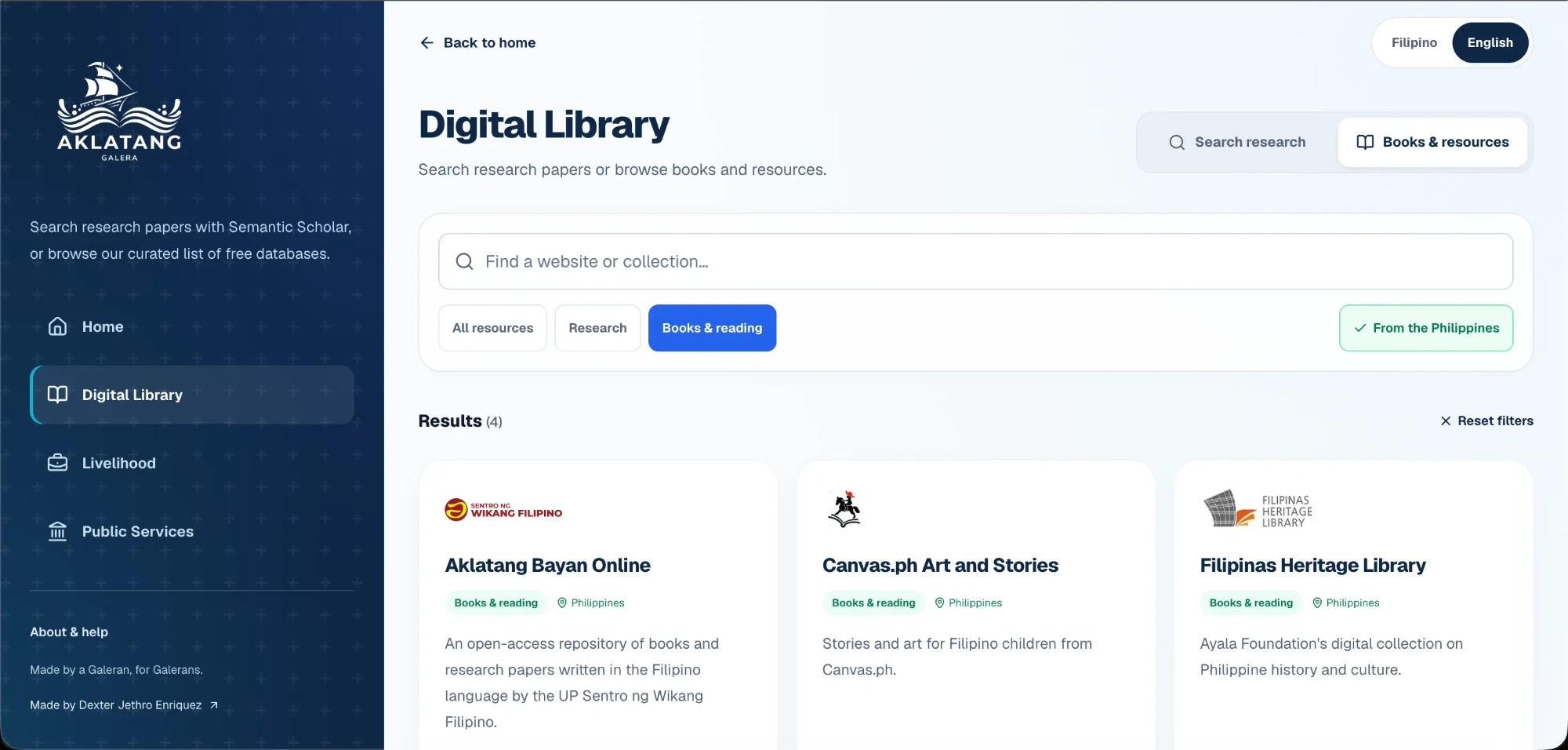
A toggle switches the whole site between Filipino and English. I had an LLM draft the Filipino boilerplate, then went through it by hand to fix the inconsistencies. A lot of it ended up semi-Taglish on purpose: some terms get too "deep" when fully translated, and the point is for a student doing research to understand it.
Built for a phone on 4G
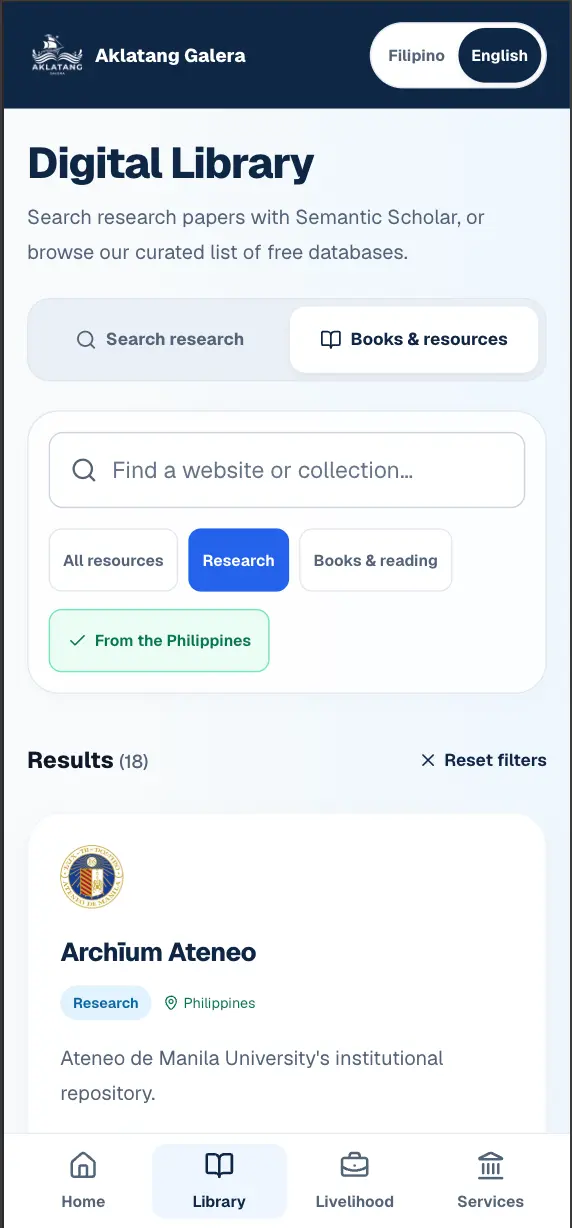
The hardest part was making sure the site was intuitive on the screen people actually use. Back home, many students don't have a laptop, but almost everyone has a phone. So the site had to work there first, without anyone needing to borrow a laptop just to do research.
Speed mattered as much as layout. The fastest connection in our municipality is still 4G, and plenty of spots barely get a signal. If the site didn't render fast there, it wasn't usable at all.
What I'd do next
Keep it fresh. I check back every so often to add links that matter and clear out the ones that have gone stale.
And someday, when there are public computers back home, I'd love for Aklatang Galera to be the first screen on them, the way those three shortcuts were in Bagong Silangan.
Why it made the four
The younger me complained about this problem all the time. It also solves one for me now: every so often, someone messages me asking where to find literature, and I'm not always around to answer. Now there's a site that answers for me, one they can always come back to.
And people do come back. Hundreds of users so far, mostly students, since it's promoted in schools, with public services as the second most used section. Research season is when it peaks: 41 users on July 16 alone. The launch post drew 175 reactions, 13 comments, and 57 shares.
Research in PG used to be pahirapan. Now it starts with three buttons.